A Really, Really, Really Long Game Of Telephone
For reference, I’m going to refer to the Game Design and Art Collaboration as the “GDA” from now on.
The GDA has had a long and proud standing history of making a game every year with all of its members. However, this history has been plagued with a problem that the game development industry knows well. Miscommunication.
Departments often didn’t collaborate with each other as much as they should have. There was a game of “telephone” that was rampant in early GDA projects, where members would have to act as a messenger between departments which ended up just causing so much confusion.
Additionally, the writing department was left out of almost every discussion. When deadlines came around, the writing department’s work was often the first to be axed from builds of the game.
So the question I asked to a bunch of GDA officers when I started this project was:
How much of that miscommunication was the pitch’s fault?
Surprisingly, a lot.
Pitches often “siloed” departments into their own chambers, meaning that a lot of departments had no reason to talk to each other, and that’s when things started to go horribly wrong.
For example, a previous game
- Design was split off into doing character abilities
- While Art was split off into doing character designs
- And Programming was split off into doing movement programming.
When it all came time for them to convene and show what they’ve done, it was all messed up. Design came up with abilities that were genuinely impossible for the characters that art had designed to do, all while programming wasn’t given any indication on what the movement should feel like according to the abilities and character designs.
So what if we developed a pitch that forced these departments to talk to each other?
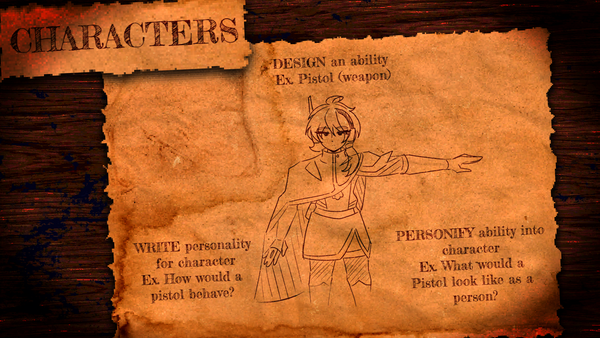
The characters of EN ROUTE demanded something from every department.
- Designers would design an ability they’d want the player to have in-game (ex. Weapons, movement, healing, etc.)
- Programmers would work closely with designers to see if that character was technologically possible and implementable within the project’s timeframe
- Artists would then personify that ability, turning them into a living character (ex. What would a weapon look like as a person?)
- Writers would then write a personality and tiny story for that character (ex. How would a weapon behave?)
- Sound designers could take the personality, look, and functionality of a character to breathe life into them
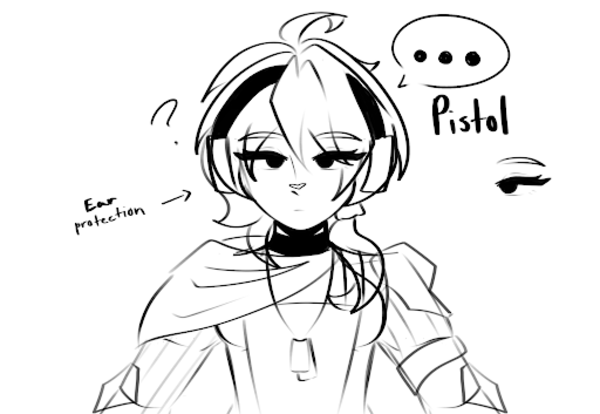
By making the core components of the game multi-disciplinary, you’re able to encourage multi-disciplinary work. This solves the telephone problem and allows for some really cool designs to be thought up by not just a few people, but a team of people working from each department.
Making People Care: Designing A Narrative About Working Together In Both Worlds
By “both worlds” I mean in-game and in the real world. I previously talked about the lack of teamwork in the first part of this write up and how I designed the game’s mechanics around that, but now let’s get how the narrative plays into all this.
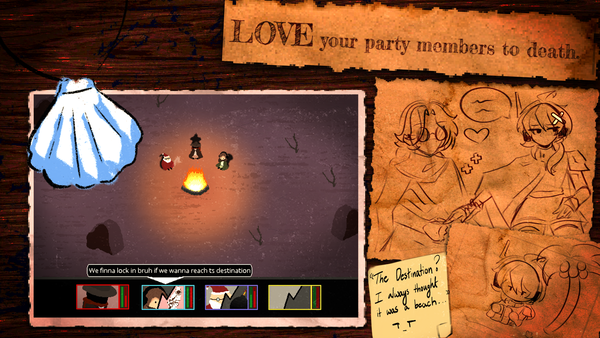
One of the core pillars of our game was “love.” There was a kind of “bond” mechanic where engaging with a party member’s story, taking care of them, and even using them in combat often was a way to give them upgrades.
This incentivizes players to actually care about their party members which gives the writing department the love they’ve deserved for the past 5000 years.
But how does this tie into the real world? By designing the narrative this way, through getting the player to care about the tiny stories from their characters, as well as the development design of characters having to be assembled by multiple departments, I hoped to create a game that got people to work and empathize with one another.
I wanted to make a game that had the player feel like they were sitting by a campfire listening and laughing with all of their friends.
And in a way, I wanted the developers to feel like that while developing this game too.